MaxAura vs Traditional Beauty Consultations: Which Wins?
A professional color and style consultation can cost $200–$800. AI does the same core analysis for under $50. Here's an honest comparison of what each gets right — and which one you actually need.
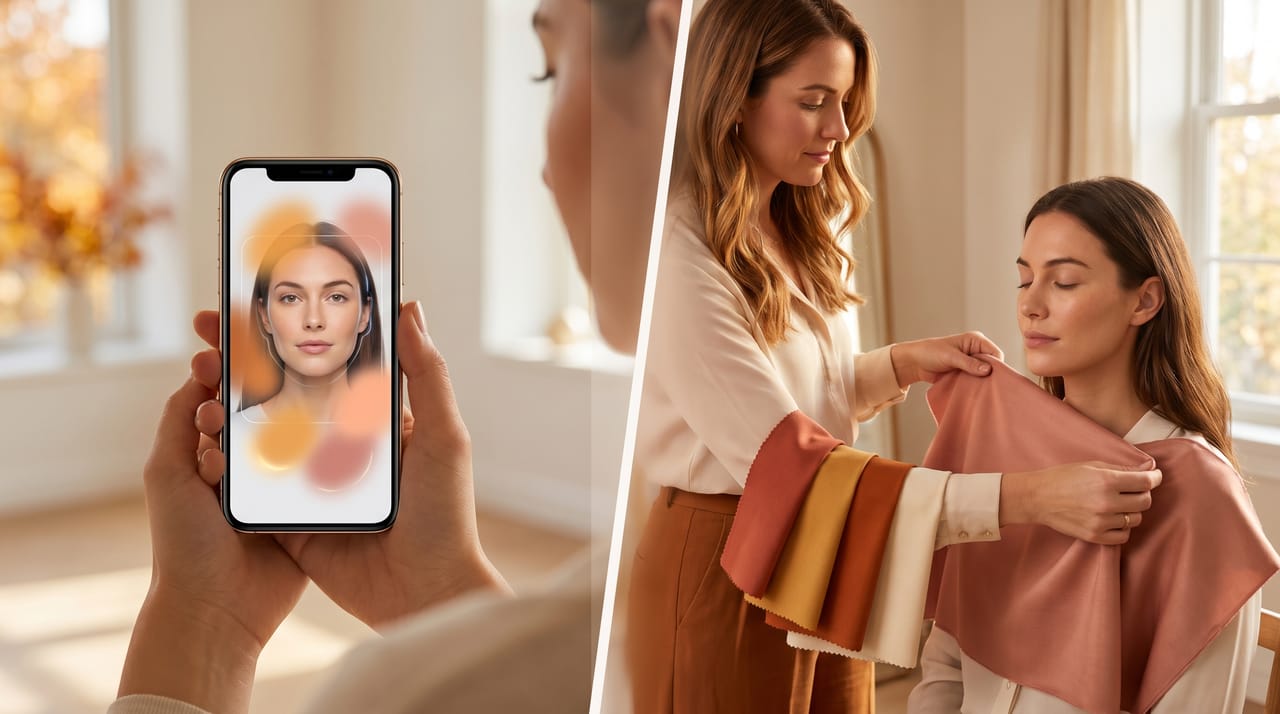
You booked the color analysis. Two hours, a stranger draping fabric near your face, $400 on the card, and a palette you mostly agreed with. It was useful. It was also expensive, hard to schedule, and impossible to repeat when you wanted a second opinion six months later.
That's the trade traditional beauty consultations have always asked of you: real human expertise, in exchange for real cost and friction.
AI changed the math. A modern analysis tool reads your face shape, undertone, color season, and best frames from one selfie — for a tenth of the price, in seconds, as many times as you like. So the honest question isn't "is AI as good as a human?" It's "which one fits this decision?" Let's compare them properly.
Full disclosure: we make MaxAura, one side of this comparison. We've kept the places where a human consultant wins.
What a Traditional Beauty Consultation Actually Costs
The friction starts with the price tag — and it's steeper than most people expect.
In the United States, an in-person color analysis typically runs $200 to $800, with most consultants charging $300–$500 for a two-to-three-hour session. In major cities, the top end is normal. Live virtual consultations are cheaper — roughly $169 to $300 — but still ask you to schedule, show up, and hope your webcam lighting cooperates.
Then there are the add-ons: travel fees, printed swatch fans ($15–$40 to ship), and follow-up sessions billed separately.
By contrast, AI-powered analysis runs about $15 to $50 — often with a free tier to start. That's not a small discount. It's a different category of spending.
What You Get From Each: A Side-by-Side
Price is only half the picture. Here's how the two approaches compare on what actually matters.
| Factor | Traditional Consultation | MaxAura (AI) |
|---|---|---|
| Cost | $200–$800 in person; $169–$300 virtual | Free to try; under $50 for full plans |
| Time to result | Days to book + 2–3 hour session | Seconds, on demand |
| Consistency | Varies by consultant's eye and training | Same measured method every time |
| Face shape precision | Visual estimate | Same method on every photo |
| Repeatable | Pay again for each session | Re-run anytime, free |
| Scope | Often color or style, per specialist | Face shape, color, hair, and eyewear together |
| Human nuance | High — reads personality, lifestyle, goals | Limited — analyzes the face, not the person |
| Privacy | In-person or live video | Photo analyzed without an appointment |
The pattern is clear: AI wins decisively on cost, speed, consistency, and breadth. Humans win on nuance and personal context. Which set of strengths matters more depends entirely on what you're trying to do.
Where Traditional Consultations Still Win
Let's be fair — an experienced consultant brings things software can't.
They read the whole person. A great stylist factors in your job, your lifestyle, how you actually want to feel in your clothes, and what you'll realistically maintain. That human context shapes advice in ways a face-only analysis can't match.
They handle edge cases. Unusual coloring, in-between seasons, the gap between what's "correct" and what you love to wear — a skilled human navigates ambiguity with judgment.
They give you the experience. For many people the session itself — the attention, the draping, the conversation — is part of the value. AI doesn't offer that.
If you want a deep, personal, once-in-a-while overhaul with a human guiding it, a professional consultation earns its price.
Where AI Pulls Ahead
For most everyday questions, though, the AI advantages are hard to argue with.
Objectivity and consistency. A consultant's read can drift with mood, lighting, and training. AI reads every photo the same way. For structural questions like face shape, that consistency is its main advantage, provided the photo is straight-on and well lit.
No friction. No booking, no travel, no two-hour block. You get an answer the moment you have a question — standing in a store, mid-shopping, deciding on frames.
It's repeatable and free to revisit. Changed your hair color? New glasses? Re-run the analysis at no cost. A consultant charges for every revisit.
It covers more in one pass. A color specialist does color. An eyewear stylist does frames. MaxAura analyzes face shape, color season, hairstyle, and eyewear together — the way these decisions actually interact on your face.
Who Should Choose Which
Here's the straight recommendation, by situation.
Choose a traditional consultation if: you want a deep, personal style overhaul, you have unusual or in-between coloring you want a human to navigate, the in-person experience itself matters to you, and the $300–$800 fits your budget.
Choose AI analysis if: you want fast, specific answers about your colors, cuts, and frames; you'd like to revisit the analysis as things change; you want all four dimensions in one profile; or you simply don't want to spend several hundred dollars to learn you're an Autumn.
Our honest take: for the vast majority of people, AI is the right first move. It answers the high-frequency questions — what colors, what cut, what frames — instantly and affordably. If, after that, you want a human to go deeper on a full wardrobe or a major style shift, book the consultation as a considered second step. Starting with a $400 session to learn your basics is paying premium prices for foundational information.
If you're not sure where to start, find your face shape and take the free undertone quiz. Both take a couple of minutes.
Q: Is AI color analysis as accurate as a professional?
For the measurable parts — undertone, face shape, seasonal palette — AI is highly consistent, often more repeatable than a human's eye. Professionals still add nuance for unusual coloring and personal lifestyle context. For most people, AI handles the core analysis accurately at a fraction of the cost.
Q: How much does a professional color analysis cost vs AI?
A professional in-person color analysis typically costs $200–$800, and live virtual sessions $169–$300. AI-powered analysis runs roughly $15–$50, often with a free tier. The price gap is large enough that many people use AI first and reserve a human consultation for deeper, one-off style work.
Q: Can AI replace a personal stylist?
Not entirely. AI excels at objective analysis — face shape, color, frame and cut direction — instantly and repeatably. A personal stylist adds human judgment about your lifestyle, personality, and goals. The best approach for most people is AI for the foundational analysis, a stylist for deeper personalized work when needed.
Q: Do I need both AI and a consultant?
Most people don't. AI answers the everyday questions — colors, cuts, frames — accurately and cheaply, and you can revisit it free as things change. A consultation makes sense as an occasional deep-dive if you want a full wardrobe overhaul or have coloring that benefits from a trained human eye.
Get Your Analysis Without the Appointment
A professional consultation is a real service with real value — but it's a several-hundred-dollar, schedule-it-weeks-out commitment to answer questions AI can answer right now.
MaxAura reads your face shape, color season, ideal hairstyles, and best eyewear from a single photo, then turns each into specific recommendations you can act on today — and revisit free whenever your look changes.
See what a consultation would tell you, in seconds. Try MaxAura's free analysis and get your complete style profile.